
 Exness
 LiteFinance
 NordFX
 XM
XM
 Vantage
 EBC
EBC
 IUX
IUX
 OctaFX
 South Africa (9)
 India (9)
 Bangladesh (12)
 Germany (9)
 Thailand (10)
 Philippines (9)
 Nigeria (10)





What is Free Margin?



Share:
Share:
Education
10 min read
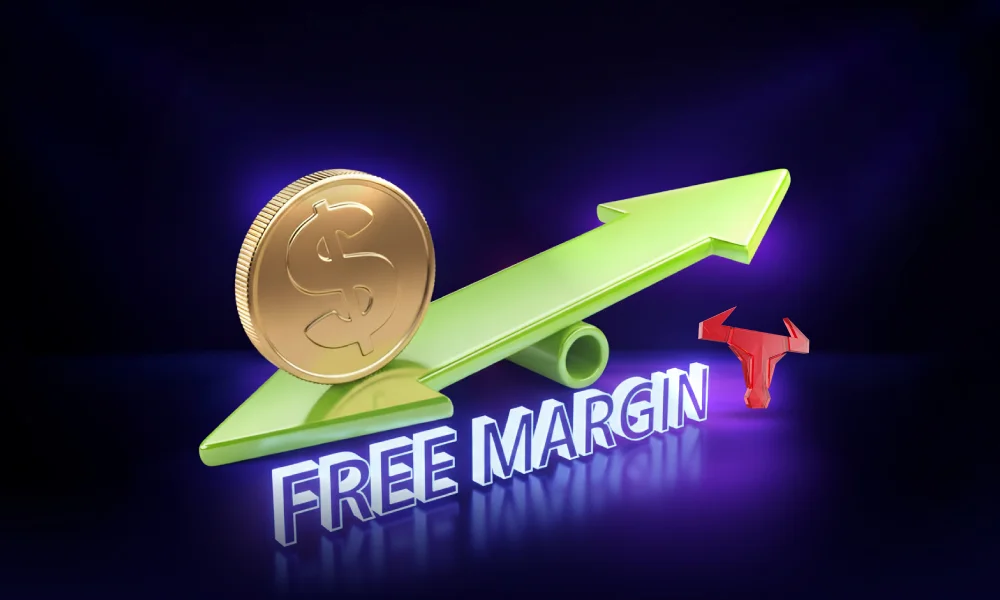
What is free margin and why does it matter so much in Forex trading?
Maybe this short story can help with context.
A trader, David, stared at his trading screen, with his heart pounding. His latest trade was moving in the right direction, but an unexpected margin call warning flashed across his account.
Confused, he scrolled through his balance, trying to understand what went wrong. That’s when he noticed that his free margin was almost depleted.
After conducting research, David found that free margin is the amount of money that is available in his account to open new trades or withstand any market fluctuations.
If you’re like David, this article will break down what free margin is, how to calculate it, and why managing it can make a difference.
Free Margin in Forex
Free margin describes the difference between equity and used margin. The free margin value shows the amount of funds that are available in a trading account to open new positions or withstand any market conditions.
If their free margin is low, traders may not be able to open any new positions. If it drops to zero, brokers will likely initiate a margin call.
A margin call is a signal from a broker that lets the trader know when they have reached the maximum usable margin level on their account.
After this signal, the trader can either close open trades or deposit more funds into the account to free up more margin.
Don’t get confused. Take a look at some key terms necessary to know going forward:
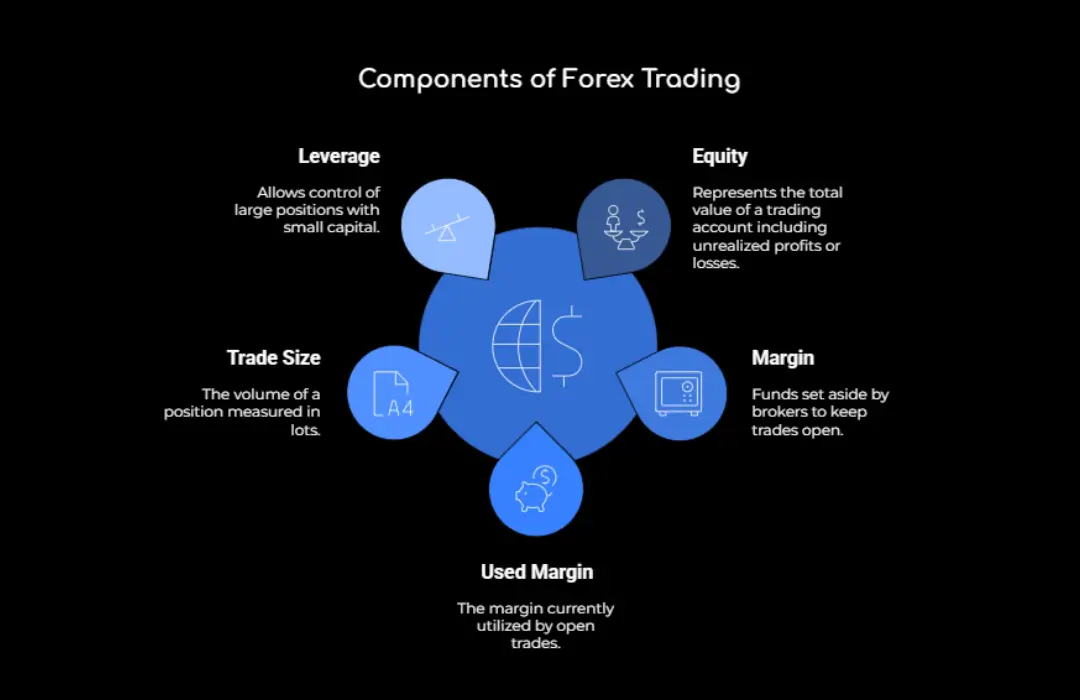
Equity
Equity is the total value of a trading account. It includes the account balance and any unrealized profits or losses from open trades.
Margin
In Forex, margin is a portion of a trader’s funds that their broker set aside in order to keep trades open. Learn more about margin trading.
Used Margin
As the name implies, used margin refers to the total margin traders are using up by having open trades.
Trade Size
Measured in lots, trade size is the volume of a position. There are four types of lots: standard lot, mini lot, micro lot, and nano lot.
The standard lot is equal to 100,000 units of the base currency, e.g., EUR/USD. So trading 1 standard lot means buying or selling 100,000 EUR/USD.
The mini lot is equivalent to 10,000 units of the base currency.
The micro lot on the other hand is synonymous with 1000 units of the currency. It is also 1/100th of a standard lot.
Finally, the nano lot, which is the smallest of the sizes, is 100 units of the base currency.
Leverage
Leverage allows traders to control a large position in the market with a small capital (margin). Expressed as a ratio, the two numbers in leverage represent different things.
Learn more about 500 leverage.
For instance, if an investor’s leverage ratio is 100:1, it means that that individual controls $100,000 worth of the trading currency with just $1000 capital.
If their leverage ratio is 25:1, they can control $25,000 worth of the trading currency with a $1000 capital.
Now that’s out of the way, let’s get down to more serious stuff.
Free Margin Formula
It is easy to compute free margin value using this straightforward method:
Free margin = Equity - Used Margin
Equity is a sum of Account balance and unrealized profits or losses.
Used margin = Trade size / Leverage
How to Calculate Free Margin (Example)
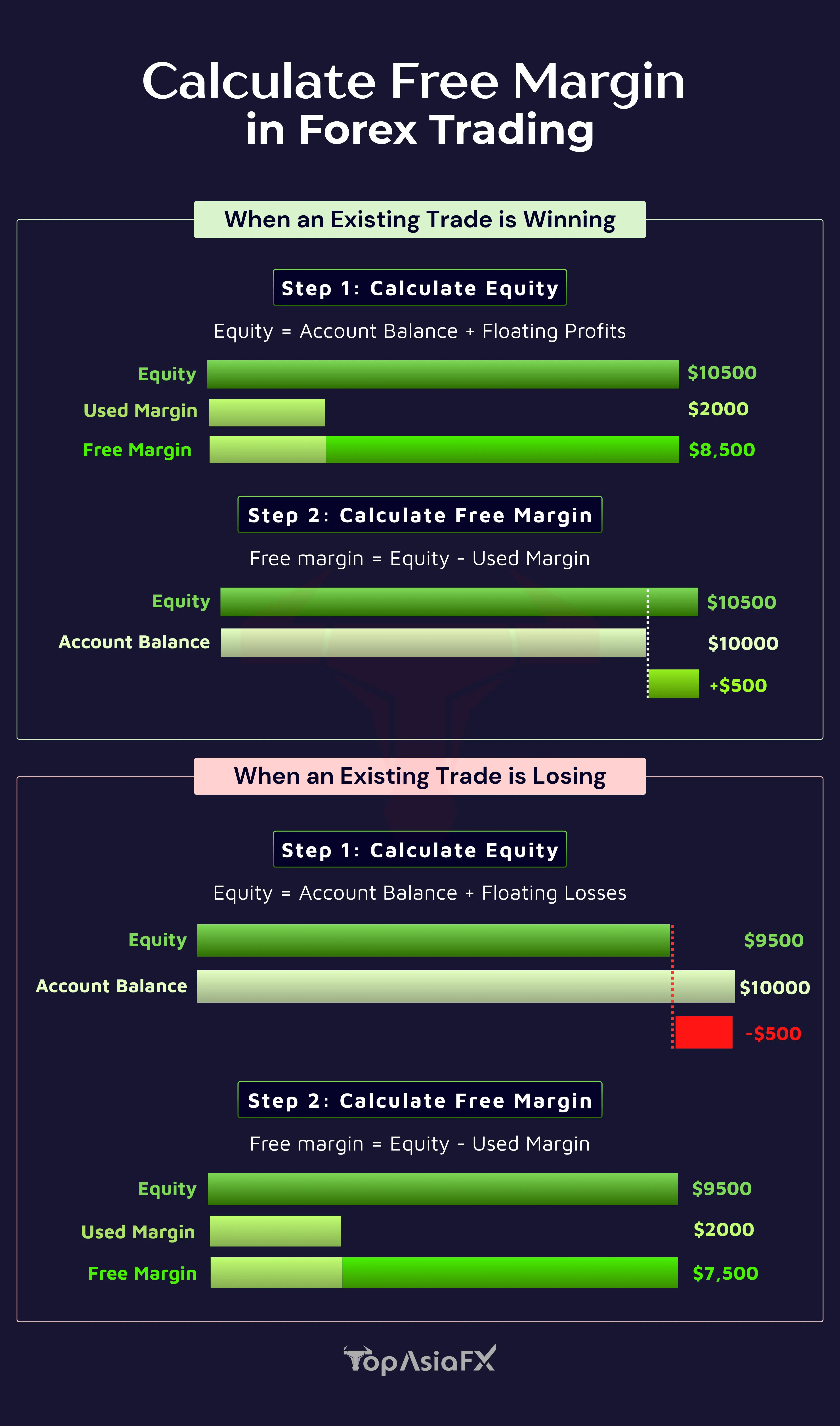
Formula ━ Free margin = Equity - Used Margin
Example 1
Trading balance is $10,000 with an open trade that resulted in a $2,000 used margin.
The unrealized profit from this trade is $500.
Let's calculate equity first:
Account balance + unrealized profit = $10,000 + $500 = $10,500
In that case, the free margin would be:
Equity - used margin = $10,500 - $2,000 = $8,500
What this implies is that this person has $8,500 available to open any new trades or navigate market movements.
Example 2
Imagine opening two trades, and each requires a $1,500 margin.
Used margin: $3,000
Account balance: $10,000
Equity: $10,000 (let’s assume the active positions have made no profits or losses yet)
We can calculate the free margin as $10,000 - $3,000 = $7,000
So what if one of the trades starts losing and goes down $500?
Equity drops and so does free margin.
New equity = $10,000 - $500 = $9,500
New free margin = $9,500 - $3,000 = $6,500
What do these numbers mean?
At this rate, if the market continues to move this way and equity drops to zero, the broker may close one or more of your open trades.
This is why it is crucial to monitor free margin closely, especially when trading multiple positions.
Free Margin vs. Margin Level
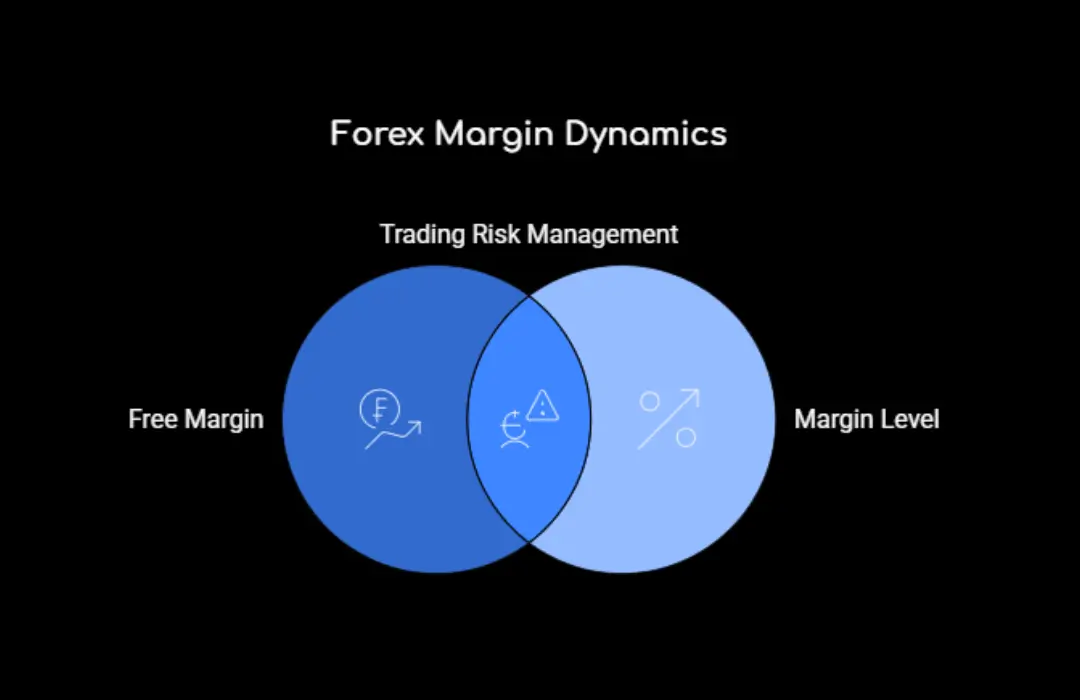
Maybe it’s because of the word “margin” but I notice that many traders confuse free margin and margin level. These two bad boys are not the same, although related.
Free margin refers to the total amount of money in a forex account that’s available for trading. On the other side of the coin, the margin level reflects how much equity is being used by open trades.
Free margin is a value that is expressed in currency. Meanwhile, the margin level is demonstrated as a percentage.
As I mentioned earlier, calculate the free margin value by subtracting the used margin from equity.
But you can calculate the margin level as:
(Equity/Used margin) x 100%
How do these two concepts work together?
These two have a positive effect on each other.
When margin level is high, it essentially means more available free margin.
If margin level falls below 100%, you may not be able to open new trades, and your broker may close any existing trades if it goes below that.
How to Increase Free Margin in Forex
Here’s how to increase free margin and trade with more flexibility:
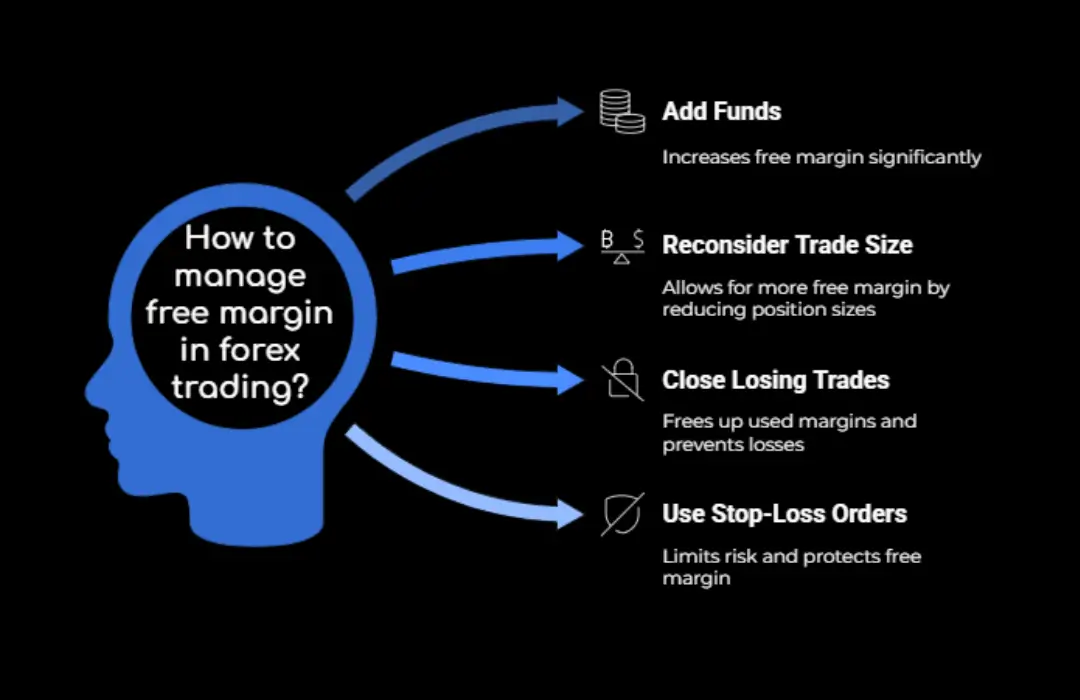
Add More Funds to Your Account
The easiest way to increase free margin in forex is to deposit more money into your account. More capital will make free margin increase significantly.
Reconsider the Trade Size
Trade smaller size positions, as they will use up less margin, which means you have more free margin available.
You can also diversify trade sizes if you are opening multiple trades. Split your capital into multiple smaller trades instead of opening one large trade.
Close Losing Trades
When trading, your ultimate goal should be to gain profit and protect your assets. So, if a trade is going towards a loss, close it. This way, you can free up used margins and prevent losses.
Use Stop-Loss Orders
The best way to limit risk and protect the free margin from unexpected market fluctuations is to implement a stop-loss strategy.
Go for Lower Leverage
When it comes to choosing a leverage ratio, I always advise against going too high. This is because higher leverage increases the amount of free margin per trade.
Try Hedging
Some more experienced traders tend to hedge instead of completely closing a trade when they are losing to the market. Hedging is opening a trade in the opposite direction to balance risks.
This way, they can maintain optimum free margin while waiting for the market to favor them again.
Scale In and Out of Positions
Scale into trades gradually rather than opening a full position at once. Doing this reduces the risk of depleting free margin, which means you can adjust the trade as the market moves.
Why is Free Margin Important in Trading?
Many traders asked this question too at the start of my trading journey.
In Forex, free margin is important because it is crucial to:
Manage Risk
With available free margin, investors can effectively prevent margin calls or forced liquidations by the broker.
Enjoy Flexibility
When you have enough free margin, you can open new trades without any restrictions.
Gain Account Stability
With excess free margin, active trades can remain open even during turbulent market conditions.
What Happens if Free Margin Drops to Zero?
If free margin reaches zero, your broker will issue a margin call. A margin call is a warning signal that signals low funds and advises adding more money to maintain active open trades or open new ones.
If unfortunately, the market continues to move against you, your broker may start closing any open trades to avert any further losses.
If you don’t want to deplete your free margin, I recommend:
Monitoring it strictly. Always keep an eye out and calculate it free margin using this formula.
Equity - Used Margin
Where equity is account balance + unrealized profits or losses, and used margin is the total margin required to keep trades open.
Free Margin in MT4: How to Find It
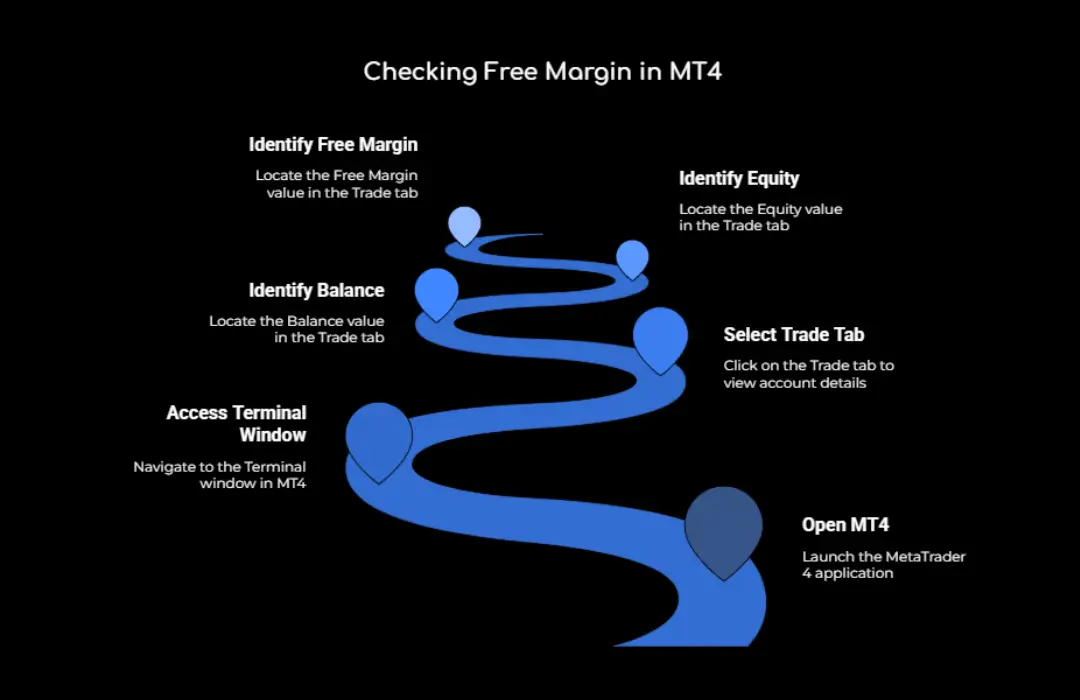
Here’s how to check free margin if on the MetaTrader 4 (MT4):
- Open MT4 and look at the Terminal window.
- Access the Trade tab. Check for the Balance, Equity, and Free Margin values.
- Monitor these values and use them to determine risk management and overall trading strategy. Learn more about trading with MT4.
Common Trading Mistakes That Reduce Free Margin
What mistakes do you think could reduce free margin? Not sure? That’s okay.
Here are the most common errors to avoid to maintain a high free margin:
Over-Leveraging
One way traders consume a significant portion of their margin is opening larger positions. Thus, making it easier to receive a margin call.
My advice? Open trades with significantly low leverage ratios.
This example will explain better.
John uses a 1:50 leverage and needs a $2,000 margin for the trade.
Meanwhile, Jade uses a 1:5 leverage and needs only a $200 margin for this trade.
Jade has more free margin available. However, the downside to Jade’s leverage ratio is that she might accumulate losses faster if the market gains against her.
Ignoring Floating or Unrealized Losses
I notice that many traders like to focus on their balance rather than equity. They forget that unrealized profits/losses reduce the value of their equity, which will, in turn, affect free margin.
Opening Too Many Trades at Once
Remember that every trade open requires a portion of your margin. So with multiple open trades, you deplete the free margin quicker and risk a margin call.
How Brokers Handle Free Margin
Different brokers have different policies, which means they have subjective margin requirements and rules for trading.
When it comes to dealing with free margin in forex, some may:
- Offer their traders negative balance protection, which ensures that they don’t lose more than they deposit.
- Increase margin requirements during periods of volatility.
- Close trades if their trader’s free margin is too low or has fallen below zero.
Always check a broker’s margin policies to understand how they operate.
Free Margin and Market Conditions
As is expected, certain market conditions affect free margin. Let’s talk about them.
High Volatility
Periods of large price movements or fluctuations can reduce free margin quickly, which means you’ll get a margin call on your account.
Weekend Gaps
Sometimes, price fluctuations happen over the weekend. When this happens, your free margin is at a high risk of dropping significantly when the market reopens.
News Events
Economic releases such as interest rate decisions or NFPs can cause sudden price movements, which could affect free margin significantly.
My number one tip? Protect your free margin. Don’t over-leverage before high-impact news events.
Final Recap
Imagine having the trading success you deserve. Sounds great, doesn’t it? This is why it is vital to manage your free margin during trading.
Free margin is the amount of money available in a trading account to open new trades and stand against market conditions.
To manage free margin effectively, make sure to monitor it all the time. Monitor free margin by computing it by hand. Let this formula guide you.
Free Margin = Equity - Used Margin
F. Nathan
Felix Nathan is a professional trader, market analyst, and business development executive with over a decade of experience in the forex and financial markets. Currently associated with AssetsFX, a leading online trading platform, Felix specializes in...