 Exness
 LiteFinance
 NordFX
 XM
XM
 Vantage
 EBC
EBC
 IUX
IUX
 OctaFX
 South Africa (9)
 India (9)
 Bangladesh (12)
 Germany (9)
 Thailand (10)
 Philippines (9)
 Nigeria (10)





Must-Have Technical Analysis Tools for Forex Trading



Share:
Share:
Education
13 min read
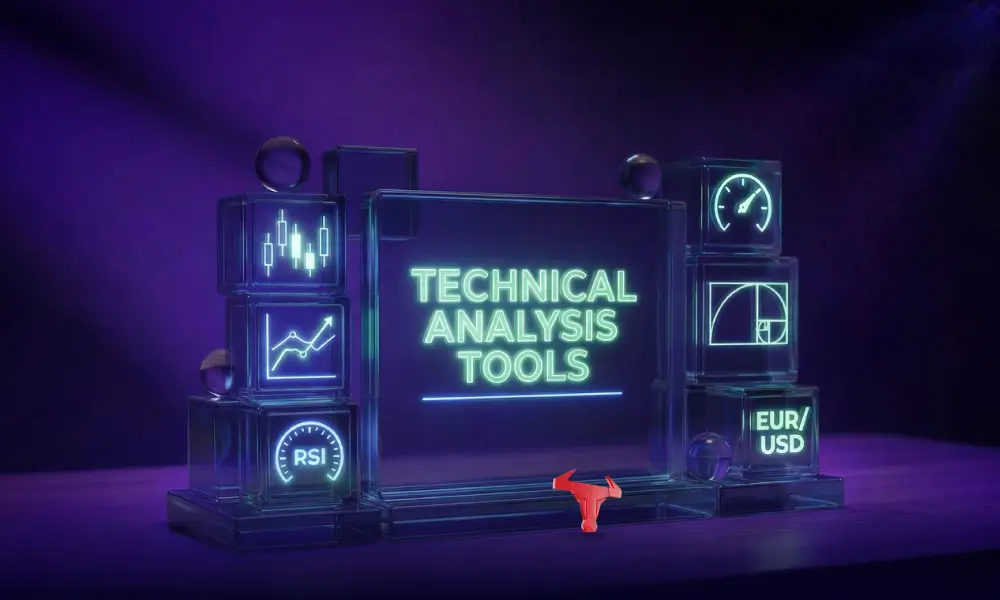
The key to success in Forex trading is to have a close eye on the market behavior. As a trader, you should do so more comprehensively. But when there are too many things happening around, it becomes overwhelming for traders.
Here is where the technical analysis tools come in. You have the luxury now to rely on the tools that can turn raw charts into sound signals. To be more precise, you can have the essential signals that can guide your entities, exits, and risk controls.
Today, I’ll introduce a few tools that you can use in real situations to manage every trade that goes in your favour. You will find these tools grouped into a few categories to make your decisions easier.
Thank me later.
What Technical Analysis Means in Forex?
Technical analysis in forex involves studying past price movements to understand what the market might do next. You look at charts, patterns, and indicators instead of economic reports or political news.
The idea is simple.
Price reflects everything the market knows at a given moment, and human behaviour repeats. So the market often moves in familiar ways.
Here is what a technical analysis tool can actually do in letting you know;
- Where the market is heading.
- When a trend is slowing.
- When a reversal is forming.
- When volatility increases.
- Where support and resistance sit.
Now, let’s think about a scenario where EUR/USD keeps bouncing from the same price level, you know, buyers defend that area. If GBP/USD breaks above a long-term trendline with substantial volume, the market is ready to move. These insights come from technical analysis, not from guessing or emotion.
Types of Technical Analysis Tools Every Forex Trader Must Know
As I promised in the opening part of this blog, I’ll break these tools into clear categories so you understand exactly what each one does. This structure will give you a sharper idea of how every tool supports your decisions.
| Simple Moving Average | Exponential Moving Average |
|---|---|
| Gives equal weight to every candle in the chosen period. | Gives more weight to recent candles. |
| Suitable for long-term trend direction. | Reacts faster to price changes. |
| Useful for traders who prefer stability over fast reactions. | Commonly used by swing traders and day traders who need quicker signals. |
How Moving Averages Identify Trend Direction?
Moving averages show trend direction by smoothing prices and revealing a clear slope. If the line rises, the market is in an uptrend. If it falls, the market is in a downtrend. When price consistently stays above the moving average, buyers control the trend; below it, sellers dominate.
Trendlines
Trendlines help you see the market’s path in a simple, almost personal way. When you connect higher lows in an uptrend or lower highs in a downtrend, the line shows you who is in control.
As you follow it, you start noticing how price reacts, how momentum slows, and when pressure builds.
Trendlines guide you through pullbacks and warn you when a breakout might be coming. So instead of guessing, you read the slope and let it show you whether buyers or sellers still have the upper hand.
Channels
Channels create a visual framework that shows how the market is trending and where pressure builds. The lower boundary often acts as support, while the upper line signals resistance. As prices move between these lines, you see clear pullback opportunities and breakout areas. This gives you a systematic way to interpret trend strength.
Volatility Tools
These tools help traders understand how much a currency pair typically moves, how quickly it changes direction, and where sudden spikes may occur. They give structure to uncertainty.
When you know the market’s typical movement, you can place stop-losses more intelligently and avoid taking trades during unstable conditions. XM provides built-in volatility indicators across all account types, enabling traders to measure volatility and manage stops with greater accuracy.
Some of the standard and most effective volatility tools are;
- Bollinger Bands.
- ATR.
- Keltner Channels.
Momentum Indicators
RSI highlights overbought and oversold zones and warns you when momentum weakens. Stochastic reacts quickly and signals short-term turns inside ranges. MACD shows deeper trend shifts through line crossovers and histogram changes.
When all three point in the same direction, you get more apparent confirmation and fewer emotional decisions.
These tools guide your timing during reversals, retests, and pullbacks, helping you avoid entering the market when strength is absent.
Charting Tools
Drawing tools come first. Fibonacci retracement helps you find areas where price often pauses or reverses during a pullback. Pitchforks add a more detailed structure by projecting three parallel lines that guide future movement. These tools work well because they’re built around repeated behaviour you see every week in Forex charts.
Candlestick patterns add context. A pin bar, engulfing candle, inside bar, or long rejection work helps you understand how buyers and sellers are fighting in real time.
When you see a clear candlestick pattern forming at a Fibonacci level or along a major trendline, the signal becomes much stronger. This is where charting tools feel most reliable.
Best Free Technical Analysis Tools for Forex Traders
You don’t need expensive software to study the market. Many free technical analysis tools give you everything you need to read trends, measure momentum, and plan trades with confidence.
MetaTrader 4 (MT4) & MetaTrader 5 (MT5)
MT4 and MT5 give you a clean way to study charts without complicating things. In simple terms, you get the tools you need to track trends, mark levels, and follow momentum. Here’s the thing: the layout is predictable, so you learn fast and build your routine without feeling lost.
In real life, that matters more than fancy features. You can draw zones, switch pairs, and test ideas with ease. The upside is that both platforms run smoothly on most devices.
The downside is that the interface feels old. But to be fair, it stays reliable even on a slow connection. If you think about it, consistency beats appearance. At the end of the day, MT4 and MT5 remain practical choices for everyday analysis.
TradingView
You get advanced charting that reacts fast, even when you switch between timeframes. The drawing tools help you map zones, mark trends, and spot patterns the moment they form. The community scripts are a big help because you can test ideas that other traders already use in real conditions.
For a smooth execution, Pepperstone and IC Markets support official TradingView integration, allowing you to place orders directly from the chart. This keeps your workflow simple and cuts down the extra steps that slow you down during active trades.
Autochartist & Trading Central
Autochartist and Trading Central scan the market for you and highlight patterns you might miss when you’re busy. You get simple alerts on breakouts, trend shifts, and support or resistance levels. This helps you act faster because you don’t have to check every chart individually.
The tools read price structure in real time and point out setups that fit your style. XM, Exness, and LiteFinance give you access to both without extra cost, so you can test signals directly in your trading routine. You still make the final call, but the scanning work gets lighter, and your focus stays on timing and risk.
How to Use Technical Analysis Tools in Daily Trading?
Using technical tools every day is not about chasing every signal. It’s about building a routine that keeps you focused and helps you read prices with less stress. Here’s how it works, broken down into simple steps.
Begin your day by looking at a clean chart with no indicators. Check the significant support and resistance zones and mark the most recent swing highs and lows. This gives you a clear picture of the market mood before anything else. If the chart feels messy, remove what you don’t need. You should see price movement at a glance.
Use Timeframes the Right Way
Check the higher timeframe first to understand the bigger direction. Then move down slowly to the timeframe you trade. This helps you avoid entering against the main move.
For example, if the four-hour chart shows a steady uptrend but the fifteen-minute chart shows noise, you know the minor pullbacks are just reactions inside a larger move. This keeps you grounded.
Apply Indicators With Purpose
Use indicators only when they answer a straightforward question. Moving averages help you see whether the price is staying above or below the trend. RSI enables you to identify momentum when the market feels tired.
Volume indicates whether a breakout has strength. Keep it simple. Too many indicators will confuse you. Stick to two or three that match your style.
Rely on Pattern Recognition
Patterns can guide your decision when the price acts unclear. Tools like Autochartist or Trading Central can highlight breakouts, triangles, and channel touches in real time. You don’t have to hunt for these manually, which saves time. You still confirm them yourself, but the scanning work gets easier.
Combine Tools Instead of Using Them Alone
Technical tools work best when you stack them. A support level, a trendline touch, and rising volume tell a stronger story together than any single tool. If you see two or three signals lining up, that’s often enough to plan a trade. If the signs clash, step back. No tool is perfect on its own.
Use Alerts and Keep It Consistent
Set alerts for price levels, trendline breaks, and indicator signals. This keeps you from staring at charts all day. A consistent routine helps you avoid emotional trades. You check the signals, confirm the structure, and enter only when it fits your plan. Over time, this makes your trading calmer and more controlled.
How to Choose the Best Technical Analysis Tools for Your Trading Style?
Picking tools depends on how you trade, not on how many indicators you can load. Each style needs its own structure and its own pace. Here’s how it breaks down in simple, practical terms.
For Beginners
If you’re new, keep things simple. Use one trend indicator with RSI to see direction and basic momentum without confusion. The built-in tools on MT4 or MT5 are more than enough at this stage. You learn how price behaves, and you avoid clutter that slows your progress.
Brokers like XM and AssetsFX work well because they offer easy platforms and all the essential indicators already installed. Your goal here is to stay focused on clean signals and build confidence one chart at a time.
For Intraday Traders
Intraday trading needs a mix of structure and speed. MACD helps you see momentum shifts, VWAP shows where the average price sits for the day, and price action guides your entries.
These three together help you avoid late entries. You also need fast execution because a few seconds can change the whole setup. IC Markets and Pepperstone are known for low-latency environments, which keep your fills cleaner when the market moves quickly.
When you trade within the day, every decision must feel tight and supported by real-time data.
For Swing Traders
Swing traders hold positions longer, so they need tools that show a bigger structure. A moving-average crossover gives you direction, Fibonacci marks reaction zones, and RSI helps you check whether momentum supports the move. You also need multiple timeframes because swings play out slowly.
Exness and Pepperstone offer flexible charting and stable overnight conditions, which help when you want clear weekly and daily views. Swing trading is calmer than intraday trading, but it still requires explicit confirmation from several angles.
For Scalpers
Scalping is all about speed and focus. You work on the M1 and M5 charts, so you need volume and volatility tools to read pressure in real time. Even small spreads matter because you aim for tiny moves. That’s why raw-spread accounts make a difference. IC Markets and Exness are strong choices because they offer fast pricing and tight spreads during active sessions.
Your goal as a scalper is simple: react quickly, take small wins, and get out before the market shifts. Matching your tools to that rhythm keeps you steady and reduces mistakes.
Final Words
Technical tools help you make clearer decisions by showing you what a price is actually doing, rather than what you think it might do.
The right broker adds to that accuracy by giving you clean data and fast execution. Pick platforms that offer strong charting, reliable indicators, and extra tools that fit your style.
Before risking money, test everything on a demo account. This helps you learn how each tool behaves in real-world conditions and gives you the confidence to trade with a steady plan rather than guess.
FAQs
Q1. Which Technical Indicators Work Best for Beginners?
Beginners get the best results using simple tools like Moving Averages and RSI. These show trend direction and momentum without creating confusion. They help you avoid overtrading and understand price behaviour before moving on to advanced tools like MACD or Fibonacci.
Q2. Why Is RSI Important in Forex Trading?
RSI helps you measure momentum. It shows when a currency pair is overbought or oversold, which can warn you about a possible reversal. Traders use it to avoid chasing prices too late and to confirm entry or exit points with higher confidence.
Q3. Is Fibonacci Retracement Useful for Daily Forex Trading?
Yes. Fibonacci retracement helps you find key pullback zones where price often reacts. Many traders use it to plan entries after a correction during a trend. It improves accuracy when combined with RSI, trendlines, or candlestick patterns on any timeframe.
Q4. Do I Need Multiple Indicators to Trade Forex?
You don’t need many indicators. Two or three tools that complement each other are enough. A trend indicator, an oscillator, and a support-resistance tool help you read direction, momentum, and entry zones without creating unnecessary chart clutter.
Q5. What Charting Platform Is Best for Technical Analysis in Forex?
TradingView, MT4, and MT5 are the most popular. TradingView offers clean charts and community indicators, while MT4 and MT5 are stable for execution and have built-in tools. Most traders prefer platforms that support trendlines, indicators, alerts, and multi-timeframe analysis.
Q6. Why Are Support and Resistance Levels Important?
Support and resistance help you see where the price usually reacts. These levels guide traders in planning entries, exits, and stop losses. They give you a clearer idea of buying and selling pressure, making trades more structured and less emotional.
F. Nathan
Felix Nathan is a professional trader, market analyst, and business development executive with over a decade of experience in the forex and financial markets. Currently associated with AssetsFX, a leading online trading platform, Felix specializes in...