 Exness
 LiteFinance
 NordFX
 XM
XM
 Vantage
 EBC
EBC
 IUX
IUX
 OctaFX
 South Africa (9)
 India (9)
 Bangladesh (12)
 Germany (9)
 Thailand (10)
 Philippines (9)
 Nigeria (10)





What is Forex?


Share:
Share:
Education
6 min read
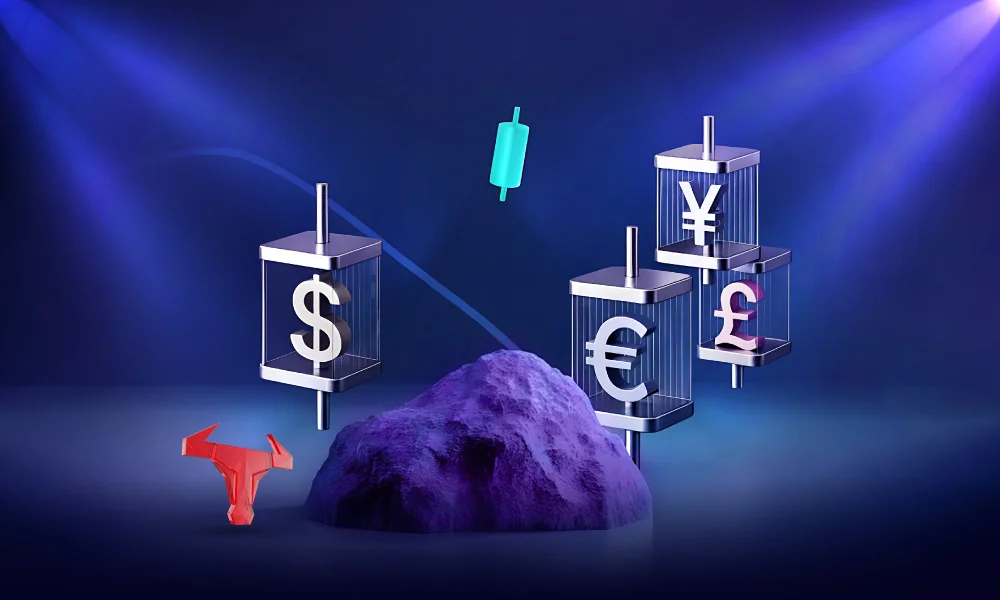
Have you ever wondered how a person can make a profit by exchanging different currencies? Or why does the dollar to any currency rate fluctuate constantly?
If you have ever considered any of the above, you were simply curious about the Forex market, the largest and most liquid financial market in the world.
Also, if you’ve ever bought a foreign currency, you’ve traded in Forex.
But it’s more than just selling dollars for euros at the airport. This guide will make Forex fun and easy.
What Is Forex?
Forex is a financial market where over $5 trillion is exchanged every day. It is the largest and the most liquid financial market in the world.
Additionally, since it is decentralized, it is not based on one single market like the stock market, it is instead based on a global network of banks, financial institutions, and individual traders.
Imagine planning a trip from the UK to the US and going to an exchange booth at the airport. Handing the Pounds over you get US dollars. This is Forex trading on a small scale.
Now, imagine doing this on a global scale day in and day out as the banks, governments, businesses, investors, and traders all exchange different currencies 24/5. This is what the Forex market is.
Basic Terms in Forex
Forex trading has its own set of unique terms that every trader should understand. Knowing these basics helps you navigate the market with confidence and make informed trading decisions.
Here are some key terms you need to know:
Pip: Pip is the minor price change as a result of currency pair trading.
Such, in the instance when the EUR/USD moves from 1.1000 to 1.1001, it represents 1 pip.
Lots: This describes the amount of currency you trade.
The common types of lot include:
- Standard Lot = 100,000 units of the base currency
- Mini Lot = 10,000 units of the base currency
- Micro Lot = 1,000 units of the base currency
Spread: The spread is the buy and sell price of a currency and what your broker makes money on.
Leverage: Using Leverage is great for boosting profits, but it can be very dangerous if the trade goes wrong and you lose more than you can afford to.
Rollover (Swap): the interest you receive or pay depending on the currency pair you are trading and the direction in which it is headed.
How Forex Trading Works
Forex trading usually happens in currency pairs. For instance:
- EUR/USD (Euro vs. US Dollar)
- GBP/JPY (British Pound vs. Japanese Yen)
- USD/JPY (US Dollar vs. Japanese Yen)
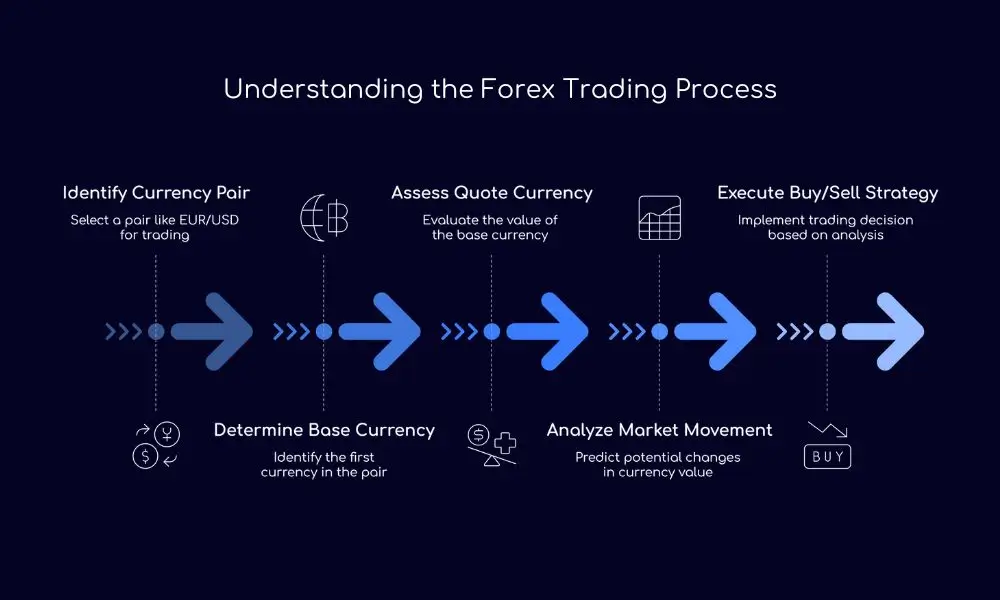
The first currency is called the base currency, which usually drives the movement of the pair, and the second currency is called the quote currency.
The idea is to sell the pair if you think the base currency will fall against the quote currency and buy the pair if you think the base currency will rise against the quote currency.
For example, Eloise is trading the EUR/USD pair.
Let’s say EUR/USD is 1.1000, which means that 1 Euro = 1.10 US dollars.
If the price rises to 1.1200, the Euro has gained value, and she makes a profit.
The Major Forex Market Players
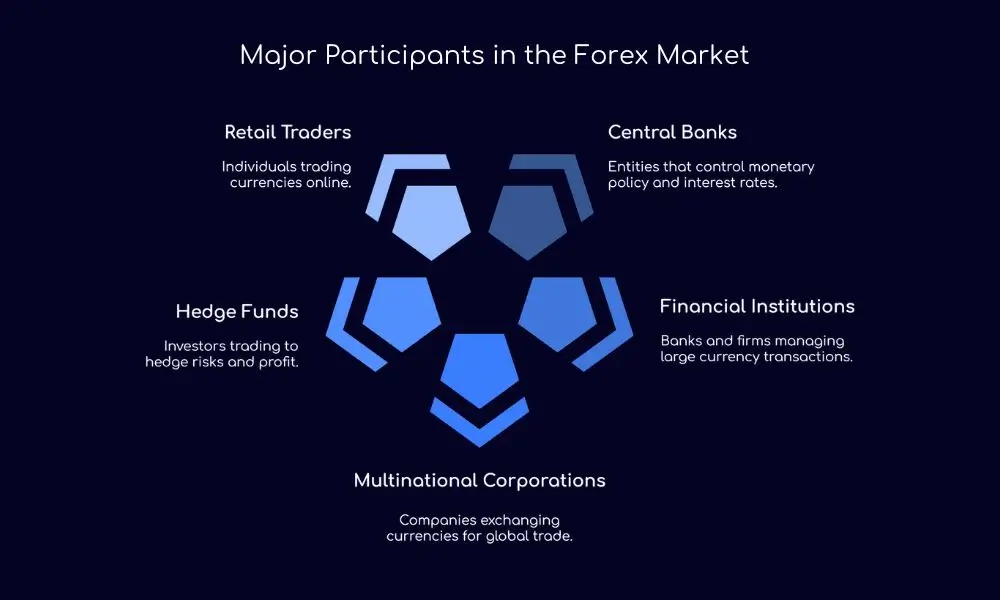
Some institutions and individual traders make up the buzz of the Forex market. These include:
- Central banks and governments: Central banks and governments play one of the most significant roles within the Forex market. They influence exchange rates by setting interest rates and controlling the money supply.
- Commercial banks and financial institutions: These guys tend to handle massive currency transactions daily for businesses and investors.
- Multinational corporations: These include companies trading internationally that need to exchange currencies for transactions.
- Hedge funds and big investors: Hedge fund investors are those who trade Forex in large amounts to hedge against risks and maximize profits.
- Retail traders: These are individual traders like you and I who speculate on currency price movements using online trading platforms.
Why Is Forex Popular?
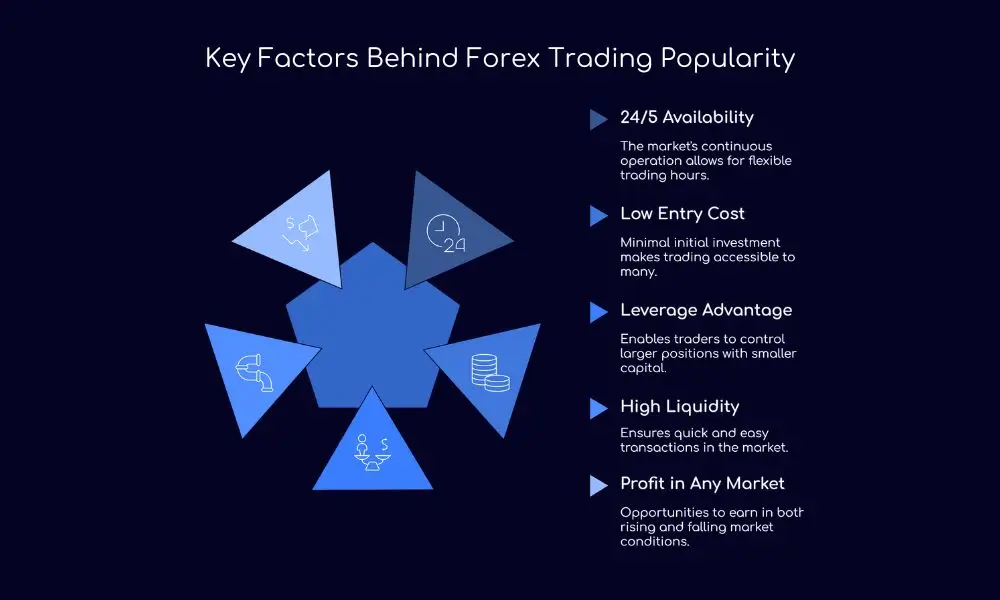
There are myriad reasons people navigate toward Forex trading, and I’ll give you the most popular ones:
- The market is open 24/5. This means traders don’t have to wait for market hours. They can trade any time, day or night.
- There’s a low entry cost. Traders don’t need thousands of dollars to start trading. Many brokers let you trade with as little as $10 to $100.
- Leverage allows you to trade big with small capital. Some brokers offer 1:50 leverage, meaning traders can control $5,000 with just $100. (Keep in mind that leverage can also multiply losses so you need to be careful).
- The market is very liquid. There’s always someone willing to buy or sell, so you can trade easily.
- There’s profit in both rising and falling markets. Unlike stocks, where traders only profit when prices go up, in Forex, you can buy or sell and make money either way.
Factors That Influence Forex Prices
Forex prices fluctuate due to a variety of global and economic factors. Understanding these influences can help traders make informed decisions and predict market movements more accurately.
Here are the key factors that impact currency prices:
- Economic indicators like reports such as GDP inflation, employment numbers have an impact on the strength of a country's currency.
- Central Bank policy such as interest rate decisions by a central bank can move a currency up or down.
- Geopolitical disturbances such as wars elections, and trade agreements have a major impact on exchange rates.
- Market sentiment; if traders feel the currency will rise or fall the market can move in either direction that suits their sentiments.
Is Forex the Next Step for You?
Forex is an exciting world that offers a lot of opportunities. However, it may not be suitable for every individual.
Here are the most relevant pros and cons of Forex so you can make an informed decision:
| Pros | Cons |
|---|---|
| The market is open 24/5, so you can trade anytime. | The Forex market is high-risk. Prices move fast, and high leverage can annihilate your account. |
| You can start trading with a low capital, even as low as $100. | There is no guarantee. Just because a currency moved one way yesterday does not mean it will go the same way today. |
| There’s high liquidity in the Forex market and easy trade execution. | It will require patience and learning. Forex is no get-rich-quick scheme. |
| There’s potential for high profits in Forex. |
Conclusion
Forex trading can be a profitable and exciting endeavor, but it requires a lot of knowledge, strategy, and discipline.
If you are interested in trading Forex, start with a demo account, and practice with fake money before investing real cash.
F. Nathan
Felix Nathan is a professional trader, market analyst, and business development executive with over a decade of experience in the forex and financial markets. Currently associated with AssetsFX, a leading online trading platform, Felix specializes in...