
 Exness
 LiteFinance
 NordFX
 XM
XM
 Vantage
 EBC
EBC
 IUX
IUX
 OctaFX
 South Africa (9)
 India (9)
 Bangladesh (12)
 Germany (9)
 Thailand (10)
 Philippines (9)
 Nigeria (10)





Optimal Trading Days in the Forex Market



Share:
Share:
Education
7 min read

Timing is everything when it comes to Forex trading, but what are the optimal days for trading Forex?
The Forex market runs 24/7, five days a week. However, traders will not get the same daily trading experience and opportunities.
Each trading day has its unique trading perks caused by different factors.
Every trader should immerse themselves in understanding these principles in their bid to figure out what works best for them.
Before we explore the details, it is important to know that not every day in the week is equally active for Forex trading.
Some days offer more trading opportunities, while others are slower with less movement.
The information below shows which days of the week usually give traders better chances to trade successfully.
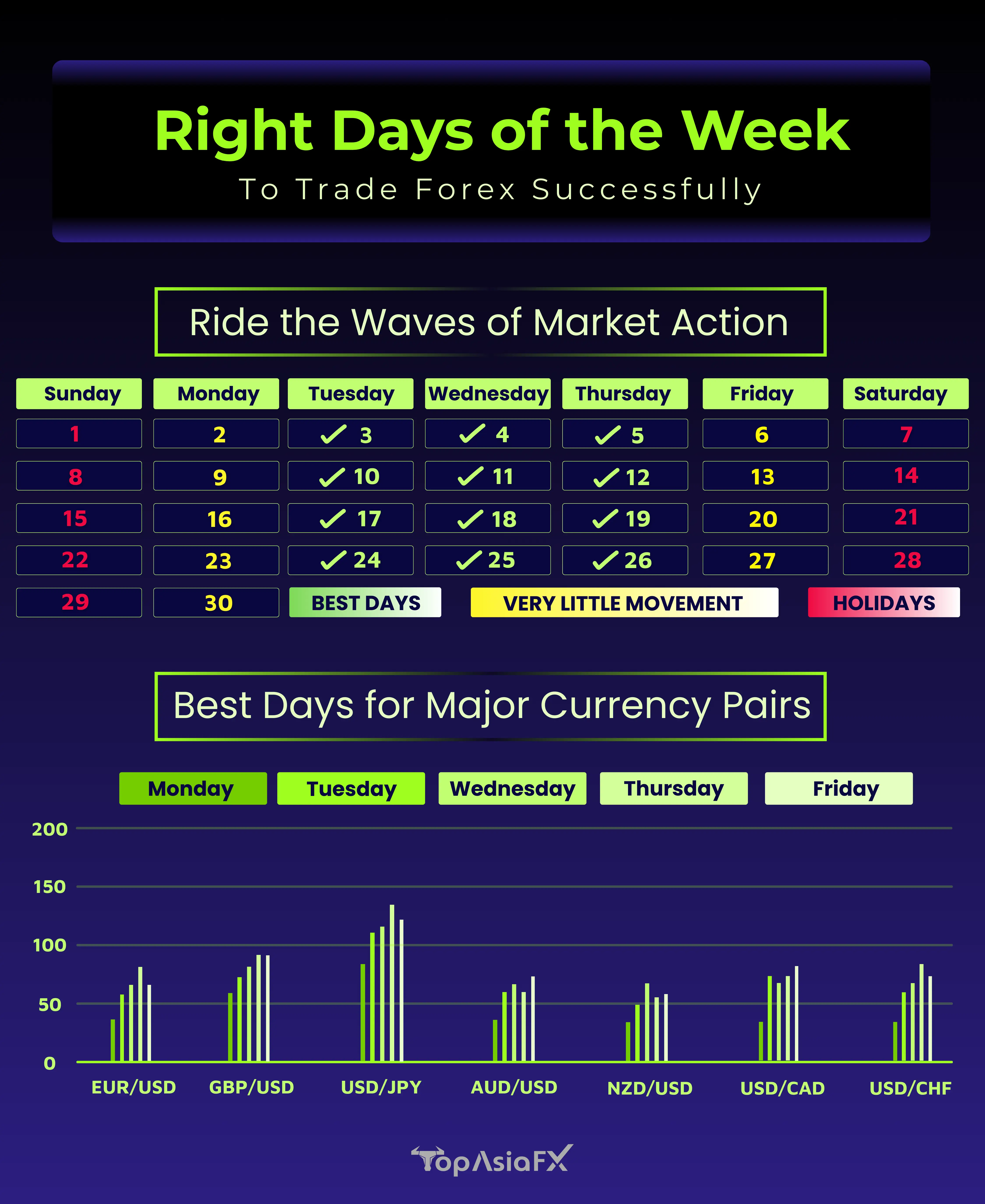
Let's break down the week to see which days are most suitable for trading.
What Are the Best Days for Forex Trading?
The best days for Forex trading are typically days in the middle of the week. I’m talking Tuesday, Wednesday, and Thursday.
This happens because major financial centers around the world are open and the large volumes of transactions are running during these days.
These days usually have increased market activity, such as volatility and liquidity, which give more room for trading.
Let’s look at the days in detail:
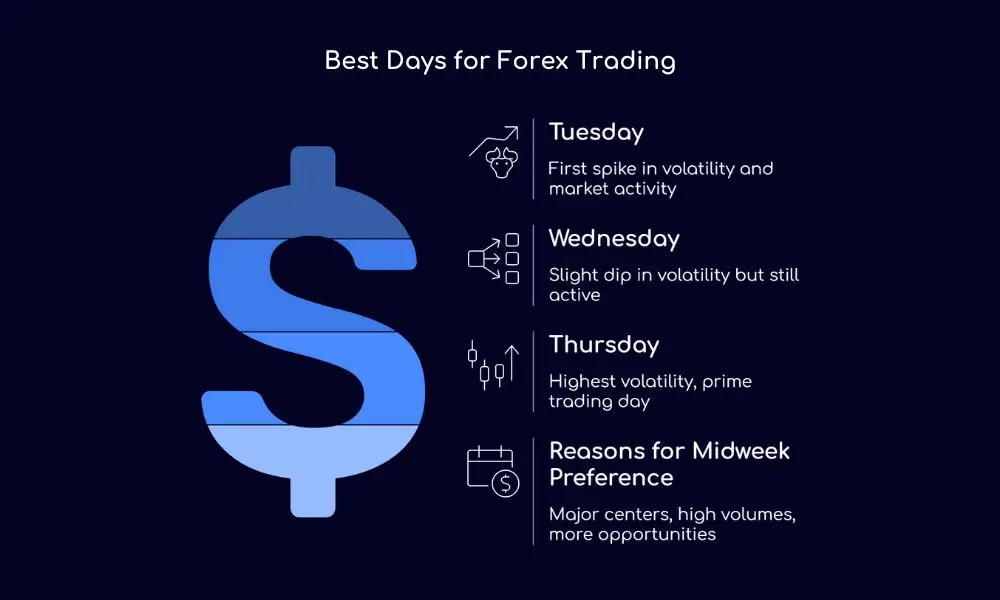
Tuesday
Tuesdays often experience the first increase in volatility and a spike in market activity
(Optimal Forex Trading Times).
Wednesday
Because of swaps, there’s usually a little drop in market volatility on Wednesdays
(Understanding Unrealized P/L and Floating P/L).
Thursday
Thursdays often have the highest volatility of all three, and in my opinion, are quite an excellent trading day (Trading Forex During the London Session).
Beyond Tuesday through Wednesday…
What Is the Second-Best Time to Trade Forex?
The second best day to trade Forex is Friday.
This is because the day typically starts with optimal activity in the morning, where currency pairs tend to overlap (Understanding Forex Trading Sessions).
However, in the afternoons, the volume of transactions tends to reduce because the week is closing in and the weekend is imminent.
What is the Least-Best Time to Trade Forex?
The least best times to trade forex are weekends and Mondays.
There’s low market activity and minimal volatility during the weekend, which occurs as a result of the time zone overlap
(Trading Forex During the Tokyo Session).
Is Monday a Great Time to Trade Forex?
No, Mondays are generally not considered a good day to trade forex, and there are a couple of reasons for it:
Low Liquidity
On Mondays, the Forex market is still waxing up from the inactivity over the weekend, and major financial centers like the London and New York sessions are not open yet.
These constraints cause fewer movements in price and trading opportunities for traders.
Price Gaps and Uncertainty
Because the Forex market is mostly closed over the weekend, price gaps may come into play when it reopens on Mondays.
This makes it hard to predict Forex price movements.
A Lack of Market Direction
Traders and institutions interested in Forex may take time to understand relevant factors like economic data and geopolitical happenings before they make any big moves.
This alone often leads to slower price moves.
Dominance of the Asian Session
Early morning trading on Mondays is often dominated by the Asian session, which happens to be way less volatile than its New York and London counterparts.
Unclear Trends
Because it is the start of a new trading week, the market is yet to establish a trading trend for the week.
This means that trading Forex on Mondays can be risky because of the indecisive price action.
Enough about the best and worst days to trade Forex, is trading better during certain months?
Find out.
Best Months to Trade Forex
The Forex market is volatile throughout the year. However, some months or periods are much more beneficial for traders.
The best months to trade Forex are March through May and September through November. I’ll explain why.
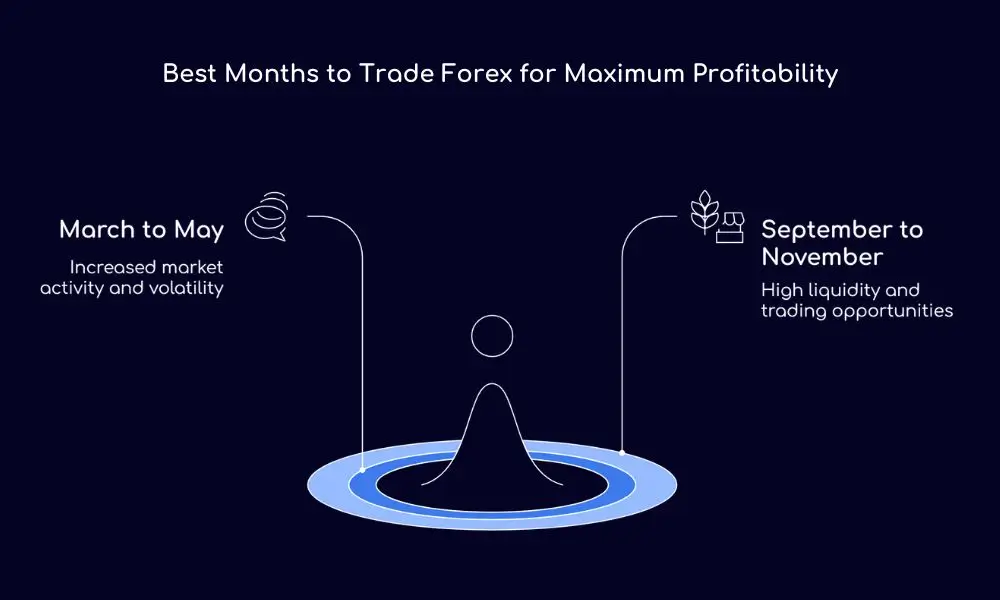
March to May (Spring surge)
There’s increased volatility during this period and stronger trends emerge as major economies release crucial economic data.
September to November (Post-summer boom)
Liquidity and volatility are at an all-time high during these months as major reports from central banks and economic activities may cause the market to move strongly.
That said, among the other months I didn’t mention, exist the worst months to trade Forex.
What Are the Worst Months to Trade Forex?
Let’s start with,
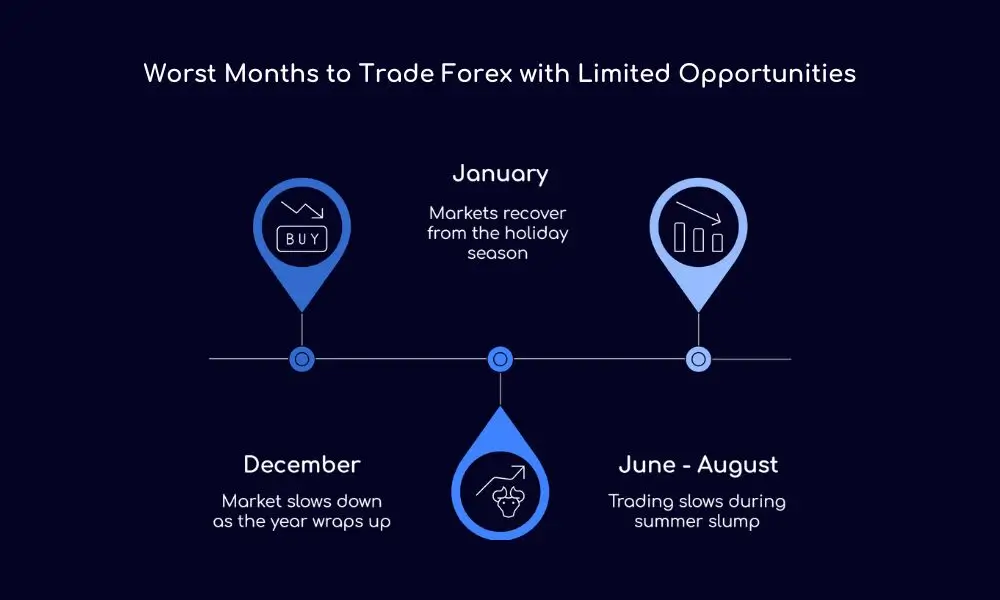
December
When the year begins to wrap up, the Forex market tends to slow down.
Also, major players within the market close their positions for the holidays.
January
At the start of the year in January, markets are still trying to recover from the slow movements of the holiday season, which means liquidity is low during this period.
June to August
Forex trading during the summer is generally slower because many institutional traders go on vacations.
This often leads to unpredictable price movements.
What Events Affect the Forex Trading Periods?
The optimal Forex trading days are primarily influenced by the factors:
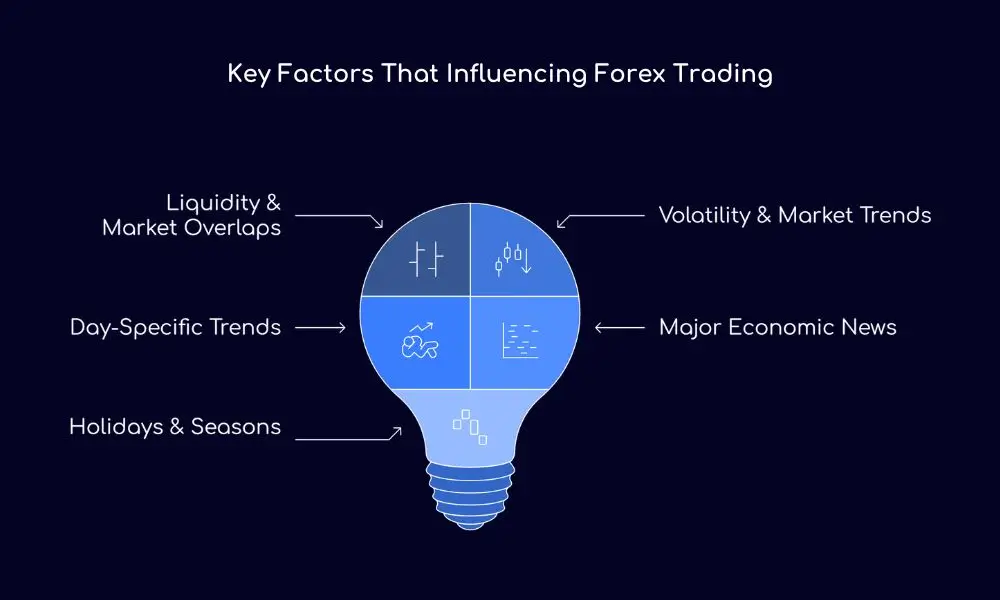
Liquidity and Market Overlaps
The Forex market appears to be in its most active state when major markets overlap. Like when the New York, Tokyo, London, or Sydney sessions overlap.
For instance, volatility and liquidity peak when the New York and London sessions overlap, which is usually between 8 AM – 12 PM EST.
Volatility and Market Trends
The Forex market is most volatile when major economic news and events arise.
However, the market sees its most price movements from Tuesday to Thursday (midweek).
Which leads me to my next point…
Day-Specific Trends
Market movement changes over the week, with each day presenting new opportunities.
For example,
Mondays open with a slow start. It usually comes with low liquidity and unpredictable prices.
In my opinion? Not a very good day for trading.
Tuesdays to Thursdays on the other hand, are good days to trade. This is because most institutional traders are active during this time and liquidity and volatility tend to peak here.
On the third end of the multi-spectrum, Fridays are considered winddown days. Liquidity drops after the New York session’s midday and market reversals can happen unexpectedly.
Weekends are pretty slow for the Forex market as market activity and volatility are low.
Major Economic News Releases and Events
Major economic data such as interest rate decisions, NFP, CPI, etc., can cause high volatility.
This is why it is good practice for traders to regularly check economic calendars. This way, they can avoid trading just before any major news events.
Holidays and Special Seasons
Forex trading slows down during the holidays because many traders close their positions and banks are closed as well.
As such, liquidity falls during Christmas, New Year, and summer (June to August).
Key Takeaways
The best days to trade Forex are the midweek days; Tuesday, Wednesday, and Thursday.
The reason for that is because market volatility, liquidity, and activity move significantly during these days.
Traders may also benefit from trading during months of high market activity, such as March to May and September to November.
F. Nathan
Felix Nathan is a professional trader, market analyst, and business development executive with over a decade of experience in the forex and financial markets. Currently associated with AssetsFX, a leading online trading platform, Felix specializes in...