
 Exness
 LiteFinance
 NordFX
 XM
XM
 Vantage
 EBC
EBC
 IUX
IUX
 OctaFX
 South Africa (9)
 India (9)
 Bangladesh (12)
 Germany (9)
 Thailand (10)
 Philippines (9)
 Nigeria (10)





How to Make Money by Forex Trading?



Share:
Share:
Education
11 min read

Forex trading is still one of the most accessible and potentially lucrative means to make money online.
The Forex market remains the largest and most liquid in the world,
With a daily trading volume of more than $7.5 trillion, attracting traders from all environments and backgrounds! Learn more about size and liquidity of the Forex market.
But how can a beginner or even an experienced trader make money trading forex in 2026?
To achieve good results in this ever-changing market, traders should rely on much more than just luck.
My well-laid-out steps and strategies to follow when making money trading forex in 2026 will give you everything you need to get started.
The first phase in my approach is to understand the basics; become one with them.
Understanding the Basics of Forex Trading
Before jumping into forex trading, it is essential to understand some basic terminology.
Learn "What is Traded in Forex?".
Here are some key concepts you should be familiar with:
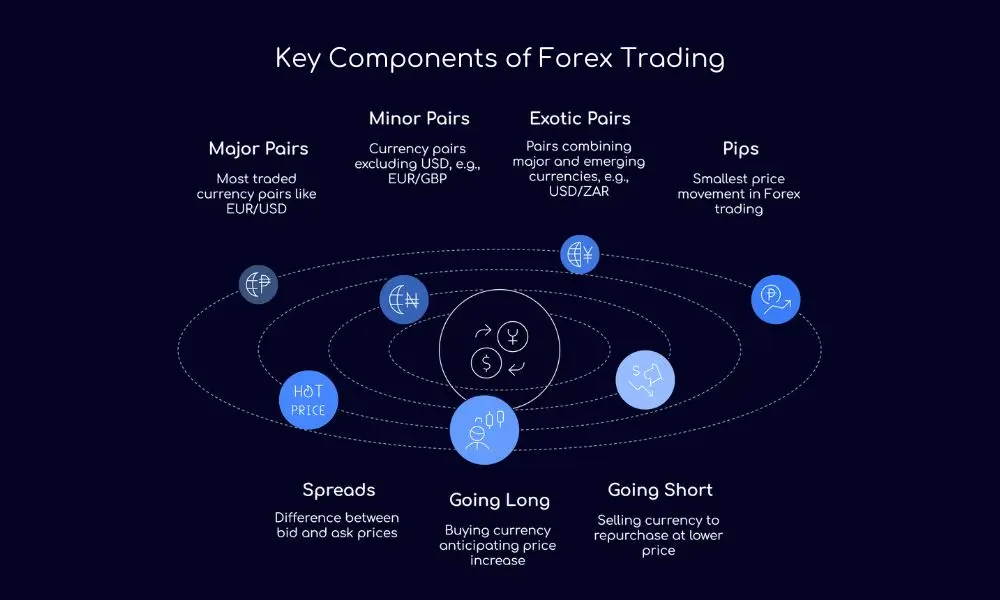
Currency Pairs
At its core, Forex is simply trading one currency against another.
These currencies are always traded in pairs, such as:
- Major Pairs: These pairs constitute the most traded currency pairs in the world. For example, EUR/USD, USD/JPY, and GBP/USD.
- Minor Pairs: Minor pairs exclude the U.S. dollar but consist of other major currencies as in pairs like EUR/GBP or AUD/NZD.
- Exotic Pairs: These include a major currency against a currency from a smaller or emerging economy. For example, USD/ZAR (U.S. dollar/South African rand).
Pips and Spreads
Pip describes the smallest movement in a currency's price.
Most pairs in forex, for instance, have their pip value set at 0.0001.
A spread is the difference between the bid and ask prices, and it is representative of the broker's commission.
The bid price is the price buyers are willing to pay for a currency, while the ask price is the price at which sellers are willing to sell their currency.
Going Long and Going Short
Going long means buying a currency pair with an expectation that the value of the base currency will go up.
Meanwhile, going short means selling the base currency in the pair to buy it back but at a lower price.
5+ Strategies to Help You Make Money Trading Forex in 2026
As much as forex trading can give you huge profits, it also has huge risks.
Which is why you will want to employ tested strategies to increase your odds of succeeding:
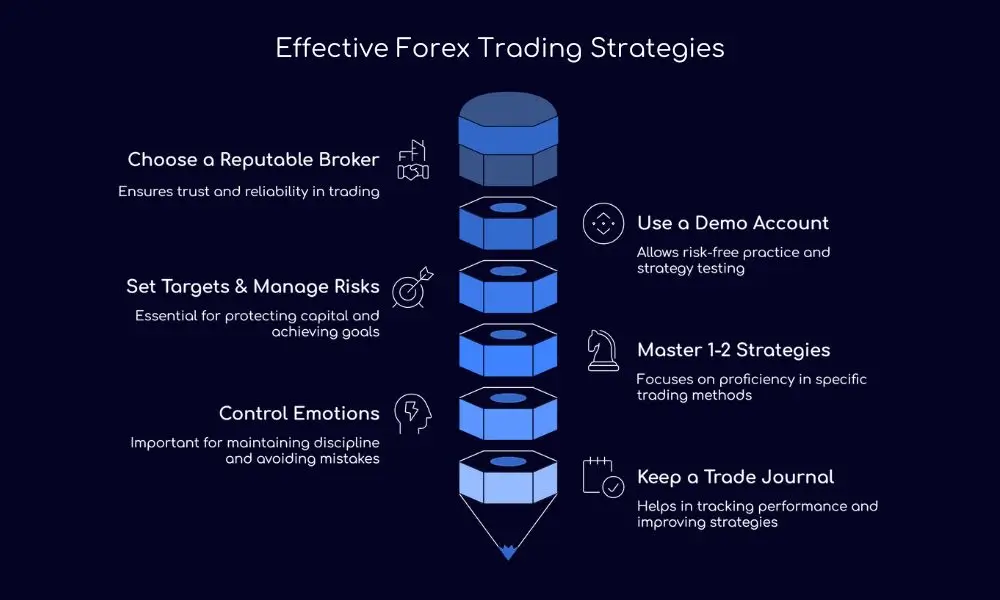
First, Choose a Reputable Forex Broker
A broker is a trader’s doorway to the forex market. Learn key players in the Forex market.
Ensure to select a well-regarded broker before getting into trading.
Look for:
- Regulations by either FCA, CySEC, or CBN.
- Narrow spreads (0.4 pips and below).
- Speedy execution of trades.
- A user-friendly trading platform.
- A broker with a relatively low minimum deposit and fees.
Some reputable brokers include Interactive Brokers, Oanda, and IG Markets.
Experiment with a Demo Account
Before putting in real money, practice trading with a demo account.
This will allow you to:
- Get used to the platform before actually trading.
- Test out strategies without any monetary risk.
- Control yourself with a practice demo before investing real currency.
Using a demo account for 3 to 6 months will help you build the necessary skills and experience.
Learn mastering Forex trading with demo accounts.
Aim at Clear Targets and Manage Risks
Set a profit goal and risk tolerance before opening a position.
Traders should strive to risk no more than 1-2% of their total capital.
A stop-loss is a good practice to limit excessive losses to protect funds.
Master One or Two Strategies
Rather than testing every strategy there is, focus on mastering one or two.
Some common forex trading strategies include:
- Trend following, which involves selling in a downtrend and buying in an uptrend.
- Scalping, where traders execute multiple small trades in a short time frame to profit from minor price moves.
- Swing trading, which is holding onto positions for days or weeks to benefit from short and medium-term price trends. Learn principles of successful swing trading.
- Breakout trading, which is the process of entering trades when prices burst through support or resistance levels.
Keep Your Emotions in Check
The most dangerous enemies of forex traders are fear and greed.
Some are too scared to let losing trades go and others are stuck in the high of profit-making positions.
There’s no way to win in either situation.
Here are some common errors to avoid:
- Chasing Losses: Don’t make reckless trades to try to win back money.
- Overtrading: Avoid making many trades simply to make money faster.
- Avoid Using a Stop-Loss: Limit losses by always implementing a stop-loss order.
Keep a Record and Analyze It
Write a trade journal to track wins, losses, and the strategies used.
It will help you see patterns and become a better trader over time.
Ask yourself,
What was my reasoning for taking this trade?
Did I follow through with my strategy,
Or was I emotionally influenced?
What can I improve on for next time?
Now, lots of traders think about the amount they need to start making money. If you are also thinking you might need $25,000 to start your trading journey, then the answer might shock you.
Learn "How to Trade Forex with $100?".
Step-by-Step Guide: How to Start Making Money Trading Forex
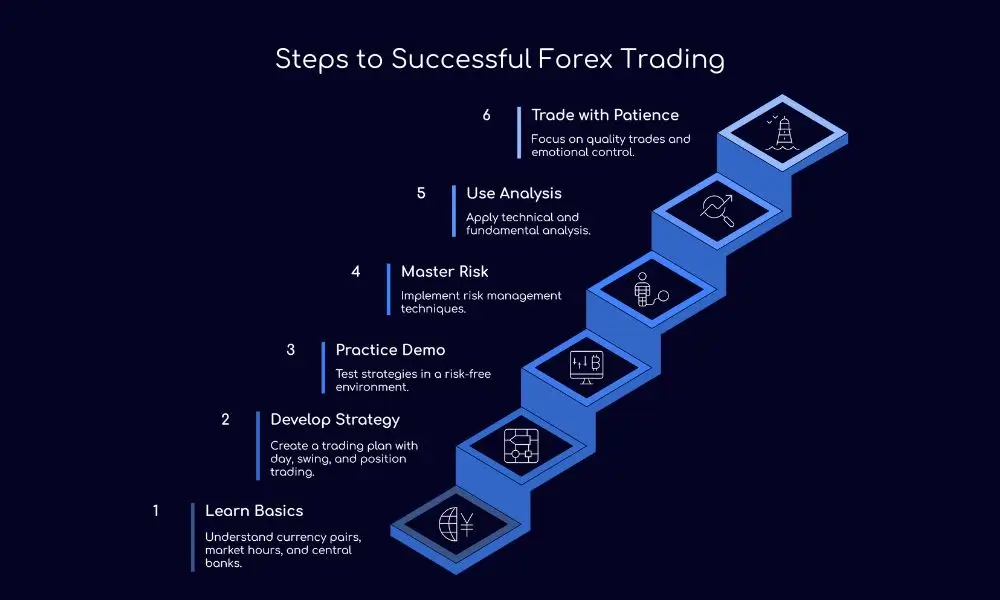
Learn What’s Necessary
Understand major currency pairs and the best ones to use for your trading session, forex market hours, and the role of central banks.
Recognize how geopolitical events, economic reports, and news affect the exchange rates.
Develop a Trading Strategy That Works
Research, do trial and error with a demo account, and find one or two strategies that work.
Some of the most common strategies include:
- Day Trading: These are trades that last for just one day or less.
- Scalping: Scalping involves quick trades that capture small price movements.
- Swing Trading: This is holding trades for about a few days, which allows traders to catch price swings.
- Position Trading: Position trading helps traders hold trades for many weeks or months, and is based on fundamental analysis.
Use a Demo Account
Most brokers offer a free demo account where traders can practice strategies in using real price movements without risking any money.
Traders can use this period to:
- Become familiar with order types.
- Test their strategy.
- Learn market movements.
Master Risk Management
Before trading with real money, consider these:
- Never risk more than 1-2% of your entire account on one trade.
- Put stop-loss orders in place to minimize massive price fluctuations from disrupting your capital.
- Don’t use higher leverage a lot; it can amplify your profit as well as losses.
Technical and Fundamental Analysis
To make money trading forex, traders need to analyze the market trends properly,
And they can do this with technical and fundamental analysis.
Technical analysis involves studying the price chart, recognizing patterns, and using indicators, like moving averages, Bollinger Bands, RSI, etc.
On the other hand, fundamental analysis refers to economic indicators such as interest rates, inflation, GDP growth, and central bank policies.
Don’t Chase the Market (Have Patience)
Only trade when it is a good opportunity.
Some of the most successful traders have fewer trades but of higher quality.
Apply risk-reward ratios wisely.
A good strategy is to consider a 2:1 reward-to-risk ratio, for each potential loss, your potential reward should be twice as much.
Finally, controlling emotions is a must in trading. Losses will occur, but do not chase after them. Stick with your plan and improve upon it over time.
Essential Trading Foundations for Forex Success in 2026
Capital Requirements & Realistic Expectations
Starting Capital Guidelines Most brokers allow you to start with as little as $100-$500, but realistic capital requirements vary by trading style. Day traders typically need $1,000-$5,000 to handle volatility and margin requirements effectively.
Swing traders can start with $500-$2,000, while position traders should consider $2,000-$10,000 minimum to withstand longer-term market fluctuations.
Profit Expectations by Experience Level Beginners should aim for 2-5% monthly returns while learning, with many experiencing losses in their first 6-12 months. Intermediate traders with consistent strategies may achieve 5-10% monthly returns.
Professional traders typically target 10-20% monthly, but this requires years of experience and substantial capital. Remember, 80-90% of retail traders lose money initially, so focus on education over quick profits.
Time Investment Reality Expect to spend 3-6 months learning basics before live trading. Developing consistent profitability typically takes 1-3 years of dedicated practice.
Daily time commitment varies: scalpers need 2-4 hours of focused screen time, swing traders require 1-2 hours daily for analysis, while position traders can manage with 30 minutes daily review after initial setup.
Advanced Risk Management Techniques
Position Sizing Formulas Use the 1-2% rule: Risk Amount = Account Balance × Risk Percentage ÷ Stop Loss Distance in Pips.
For example, with a $5,000 account, 2% risk ($100), and 50-pip stop loss, your position size should be $100 ÷ 50 = $2 per pip.
This mathematical approach prevents emotional sizing decisions and preserves capital during losing streaks.
Correlation Analysis Understanding currency pair correlations prevents overexposure. EUR/USD and GBP/USD typically move together (positive correlation), so trading both simultaneously doubles your risk.
Use correlation coefficients: values above 0.7 indicate strong positive correlation, below -0.7 show negative correlation. Diversify by trading pairs with low correlation (0.3 to -0.3) to spread risk effectively.
Portfolio Diversification Strategies Limit exposure to any single currency to maximum 6-8% of your account. Trade different session times (Asian, European, American) to capitalize on various market personalities.
Mix major, minor, and carefully selected exotic pairs based on your experience level. Consider commodity currencies (AUD, CAD, NZD) alongside traditional majors for broader exposure.
Psychological Trading Aspects
Common Cognitive Biases Confirmation bias leads traders to seek information supporting their positions while ignoring contradictory signals. Overconfidence bias causes traders to increase position sizes after wins, often leading to significant losses.
Loss aversion makes traders hold losing positions too long hoping for recovery. Recognize these patterns by keeping detailed trade journals noting your emotional state during each decision.
Mental Preparation Techniques Develop pre-market routines including chart analysis, economic calendar review, and goal setting. Practice meditation or deep breathing exercises to maintain calm during volatile periods.
Create trading checklists to ensure consistent decision-making under pressure. Set daily loss limits and walk away when reached, regardless of market conditions or "revenge trading" urges.
Recovery from Losses After significant losses, reduce position sizes by 50% until confidence returns. Review what went wrong without self-blame—treat losses as education costs.
Take breaks from live trading to practice on demo accounts and rebuild psychological capital. Implement strict rules: no trading when emotional, angry, or desperate to recover losses quickly.
Market Timing & Sessions
Optimal Trading Hours the London-New York overlap (8 AM - 12 PM EST) offers highest liquidity and tightest spreads for major pairs. Asian session (7 PM - 4 AM EST) suits AUD, NZD, and JPY pairs with lower volatility.
European session (3 AM - 12 PM EST) provides strong trends for EUR and GBP pairs. Avoid trading during major holiday periods when liquidity drops significantly.
Session-Specific Strategies Asian session favors range-trading strategies due to lower volatility and clearer support/resistance levels. European session often shows strong directional moves perfect for trend-following strategies.
American session creates high volatility ideal for breakout trading but requires tighter risk management. Friday afternoons typically see reduced activity as institutions close positions.
Economic Event Timing Major news releases (NFP, interest rate decisions, GDP) create 30-60 minutes of extreme volatility. Plan trades around these events: either close positions beforehand or prepare for wider spreads and potential slippage.
Central bank meetings and speeches can shift market sentiment for days or weeks, requiring strategy adjustments. Use economic calendars to avoid unexpected volatility that could trigger stop losses prematurely.
Closing Thoughts
Making money in forex trading in 2026 is possible.
However, It requires knowledge, discipline, and a sound strategy.
The most successful traders set out their goals clearly, cut back on risks, and continuously learn through the mistakes and successes of others.
Start small, master a strategy, and invest more when you start making consistent profit.
And, above all, view trading as a game of probability rather than a sure way of making money.
F. Nathan
Felix Nathan is a professional trader, market analyst, and business development executive with over a decade of experience in the forex and financial markets. Currently associated with AssetsFX, a leading online trading platform, Felix specializes in...