
 Exness
 LiteFinance
 NordFX
 XM
XM
 Vantage
 EBC
EBC
 IUX
IUX
 OctaFX
 South Africa (9)
 India (9)
 Bangladesh (12)
 Germany (9)
 Thailand (10)
 Philippines (9)
 Nigeria (10)





When Can Beginners Start Practicing Scalping in Forex Trading?



Share:
Share:
Strategy
7 min read

Ever stared at a forex chart and thought, “Could I really pull off this scalping thing?”
You’re not alone.
Many beginner traders are drawn to scalping because of its promise of quick profits and high-paced excitement. But here’s the kicker: not every beginner should go into scalping right away.
So, when can beginners start practicing scalping in forex trading? Let’s break it down clearly and realistically.
So, When Can I Start Practicing Scalping as a Beginner in Forex?
Beginners can start practicing scalping in forex trading once they understand basic market functions, have demo trading experience, and can control their emotions under pressure. Scalping is a fast-paced strategy that requires split-second decision-making.
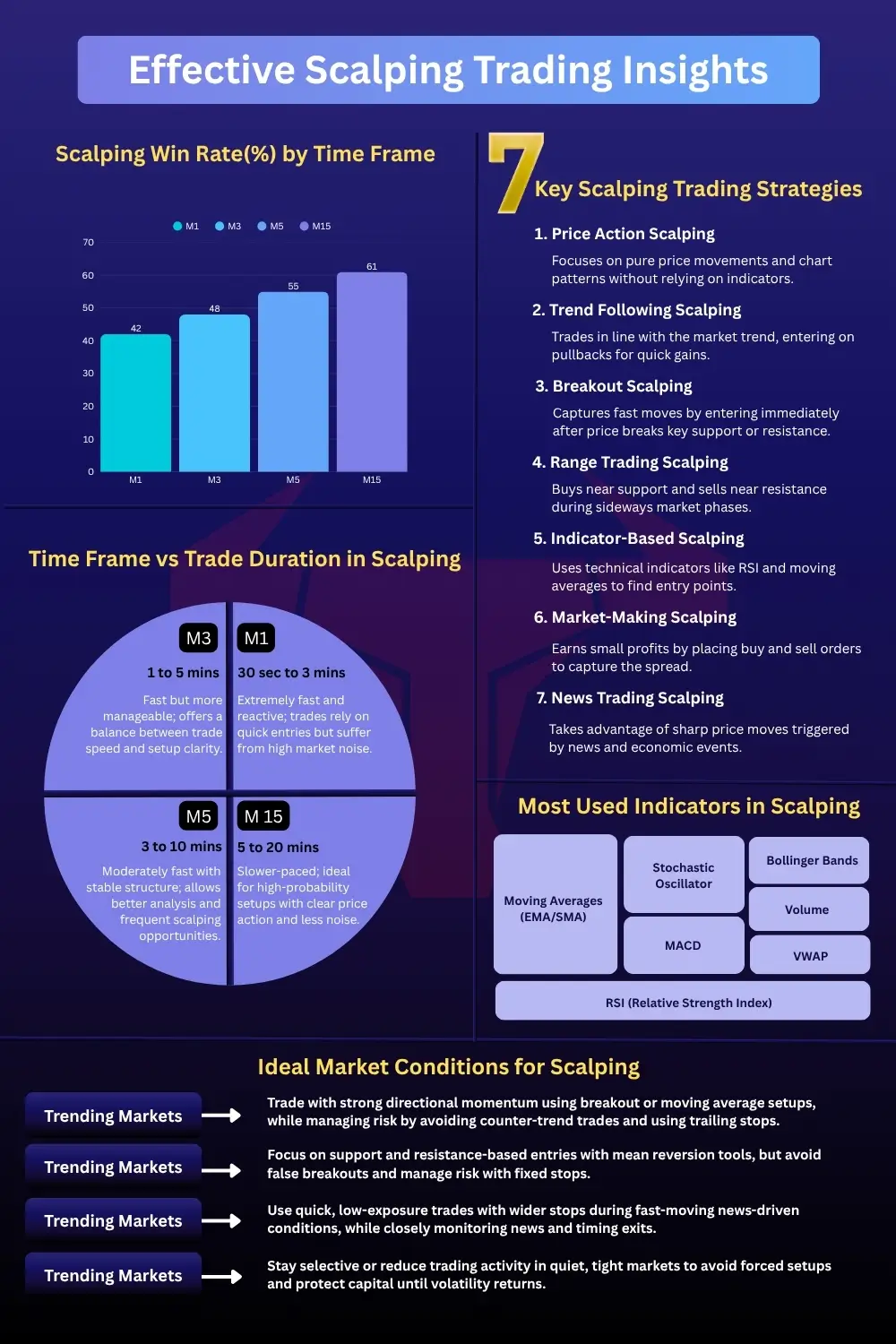
Before getting started, it's important to understand suitable market conditions, effective timing, and the tools commonly used. The infographic below provides a clear overview to help you get started with confidence.
It’s not ideal for someone who’s still figuring out how order types, spreads, or leverage work. You should have a solid grasp of how the forex market operates, especially how prices move, when volatility spikes, and how liquidity can impact your trades.
Before attempting to scalp with real money, it's essential to gain experience in a demo trading environment.
This allows you to simulate trades in real market conditions without risking actual capital. Use this time to get comfortable with technical tools, identify which indicators suit your trading style, and refine your ability to enter and exit quickly.
Speed and timing are crucial when scalping, so practice until navigating your platform becomes second nature.
Just as important as technical skill is emotional control. Because scalping involves many small trades, losses are inevitable. The key is to stay disciplined and stick to your plan, even when tempted to chase losses or overtrade.
Emotional decisions can lead to impulsive moves, which scalping doesn’t forgive. Confidence, not recklessness, is what separates successful scalpers from frustrated beginners.
Once you’ve developed a rhythm in demo trading and built trust in your system, you can gradually transition to a live account, starting with small positions to keep risk manageable. Scalping may be challenging at first, but with consistent practice and strong risk management, it can become a powerful strategy in your trading toolkit.
Scalping Involves…
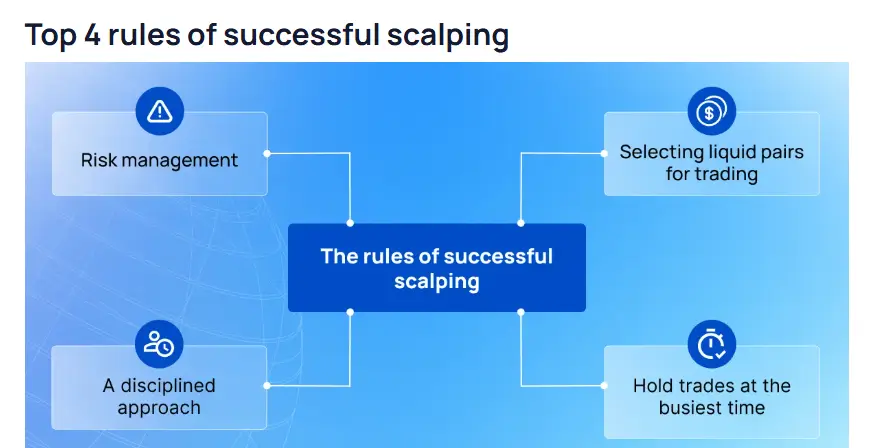
Small Price Movements, Using Highly Liquid Pairs
Scalping is about carefully analyzing short-term price action, spotting quick opportunities, using highly liquid currency pairs, and entering and exiting trades in rapid succession.
Most scalpers use one-minute to five-minute charts to identify patterns, breakouts, or momentum shifts. The goal is to capture a few pips of profit from each trade, then move on to the next one.
Speed and Volume: Stick to the Busiest Market Times
Because profits per trade are small, scalping relies heavily on volume, making dozens or even hundreds of trades in a session to accumulate gains.
That means precision is key: each entry and exit must be calculated, and there's little room for error. Speed matters too, as price movements can reverse in an instant.
The faster you can analyze, decide, and execute, the more effective your scalping will be.
High Mental Demand
The speed needed in scalping comes with mental strain.
Scalping is intense and can quickly become exhausting. You have to maintain laser focus for extended periods, resist emotional triggers, and stick to your risk management rules.
It’s not a “set and forget” style of trading; it is a fast-paced and hands-on style. Unlike swing or position traders who might monitor the markets once or twice a day, scalpers are glued to their screens while actively trading.
High Discipline
So while scalping can be rewarding, especially for those who thrive in fast environments, it requires preparation, discipline, and emotional control.
It is a strategy that rewards consistency and punishes hesitation. If you're the type of trader who enjoys quick decisions and instant feedback, scalping might be for you, but only if you’re willing to put in the work.
Risk Management
Even if you’re trading small positions, losses can stack up fast.
Scalpers must be laser-focused on managing risk, like using tight stop-losses, calculating realistic profit targets, and sticking to a defined trading plan.
4 Signs You Are Ready to Start Scalping as a Beginner
You've Mastered the Basics of Forex Trading
Scalping isn’t where you learn what a pip is. You should already understand:
How currency pairs are structured (e.g., EUR/USD, GBP/JPY), what spreads are and how they affect your cost, how to set stop-loss and take-profit orders, and the difference between market and limit orders.
If you're still fuzzy on these, it's best to sharpen your basics first.’
You’ve Logged Hours in a Demo Account
A demo account is your training ground. Before risking real money, make sure you've practiced high-frequency trades, tested at least one or two scalping strategies, and learned how to enter and exit positions with precision.
Once you start seeing consistent performance in your demo account, you're likely ready to try the real thing.
You Can Handle Fast-Paced Decisions
Scalping is not for the hesitant. You’ll need to react to price changes in seconds, stick to your strategy without hesitation, and stay calm during rapid market movements.
If you panic under pressure or hesitate to enter trades, scalping might frustrate you more than it rewards you.
You’ve Chosen the Right Broker and Platform
Scalping depends on speed and cost. You’ll want a broker that offers low spreads and fast execution, a scalper-friendly policy (some brokers restrict the practice), and a reliable, lag-free trading platform like MT4, MT5, or cTrader.
Your tools need to work as fast as you think because every pip counts.
Tools and Timeframes You Need as a Beginner Scalper
Start with a 5-minute or 1-minute scalping strategy if you're confident in your skills. But don't rush into ultra-short charts without testing.
Use technical indicators like moving averages or RSI to guide your entries and exits, but keep your charts clean.
Avoid getting overwhelmed. Focus on one or two currency pairs that are liquid (e.g., EUR/USD or GBP/USD). The tighter the spread, the better for scalping.
Avoid These Beginner Mistakes While Scalping
Overtrading
Scalping doesn’t mean you need to flood the market with trades. Taking 30 trades in an hour might sound productive, but it often leads to mental fatigue, sloppy execution, and motional burnout.
Quality over quantity is the real scalper’s mantra. Stick to high-probability setups instead of chasing every price tick.
Ignoring Trading Costs
Every trade comes with a cost, usually in the form of a spread or commission. New traders often overlook how much this eats into profits.
For example, if you’re aiming for a 3-pip profit per trade but the spread is 2 pips, you’re only making 1 pip (if the market even moves in your favor).
Always factor in spreads and fees when setting targets. Otherwise, you’ll be spinning your wheels.
Impulsive Trading
Scalping might be fast-paced, but it’s not freestyle trading. Entering trades on instinct or because the price “looks right” is a recipe for inconsistency.
Successful scalpers follow a strict trading plan, use specific criteria for entry and exit, and rely on tested setups and indicators.
Trust the process, not your gut, especially when the market is volatile.
Lack of Patience (Yes, Really)
Scalping may be fast, but waiting for the right setup is important. Rushing into trades because you’re bored or anxious often leads to losses.
Smart scalpers know that not every minute offers a trade-worthy opportunity and sitting on the sidelines is sometimes the best move.
Learn to wait. Scalping is like sniping, not spraying bullets at random.
So, When Should You Start Scalping?
Start scalping when you’re not trading on emotion, but on a plan.
If you've practiced enough, understand your tools, and respect the market, then you're ready to begin experimenting with live scalping, preferably with small positions and a rock-solid mindset.
F. Nathan
Felix Nathan is a professional trader, market analyst, and business development executive with over a decade of experience in the forex and financial markets. Currently associated with AssetsFX, a leading online trading platform, Felix specializes in...